Friday, September 18, 2015

Tales of the real, the imaginary, the online and the face-to-face

Some considerations on a missing link.

One of my favourite novels ever is The French Lieutenant's Woman by John Fowles. I just fell for the way it is written, the links between past and present all seasoned with beautiful use of language by a writer with a wide culture who can relate Victorian dresses to Egyptian horror vacui if he needs to make a point. I was so moved by the novel that I secretely began to dream that one day, some day, I would visit Lyme Regis to see the sights where the movie was shot.

Many years later my dream came true. I took an early morning train from London to Exeter St. Davis and a bus to Lyme. I remember the bus driver greeted everyone by their first name. He said to me, "Hello, dear". I felt at home.

I spent six hours travelling from and back to London and only two hours in Lyme. I could speak about those two hours for ages. I have never, ever forgotten it. Being in a place I had read and re-read about for years while I was much younger and then being there -I was in my late 20s- was as if past and present borders had become blur, but not with the effect of confusion at not being able to tell one from the other. It was the blending of my present and past into something new that resisted the language prison for lack of a name or another experience to compare.

I took photographs with my father's camera. I asked a stranger to take one of me on the Cobb looking just as Meryl Streep on the movie. I spent 20 minutes of my short visit silently sitting on th edge of that old Cobb looking into the sea. I thought about how small whatever problems or challenges I had back in Argentina seemed. I convinced myself it was so. They were far. Far away.

The main street in Lyme seemed taken from a childhood story book illustration. I stood at the door of a fossil shop and noticed some postcards on a metal holder at the door. I took one sepia photo which had been taken from the same spot I was standing at. It was marked Broad St., 1900. I held it up against the real street to confirm my suspicion. Yes, there was hardly any architectural difference between the sepia copy in my hands and the real, present street behind. I noticed a traffic light that broke the spell. I decided I would not take a new photo. I couldn't take a shot more faithful to the reality of me there and then in front of that sight. I bought the postcard.

One of my best friends back in Buenos Aires, after hearing me pouring all the details of the trip and my sensations, said that I had found out there in Lyme something that had always been inside. That made sense to me at the time, for most of my feelings in London were not just about the surprise of my first visit, but the confirmation of something I had always known. It felt more like coming back there.

This blogging journey -with interruptions and all- has been like reading a novel I like so much that it leaves me with a willingness to travel. Only this time I know that if Idid travel, the differences between the real world I could see there and the novel I've been reading and writing here will not be that many. I should not be so surprised to confirm that what I read is real.

But how real?

In that book, John Fowles makes a kind of experiment pretending he is writing a novel that he, as a writer, cannot predict the ending. He is discovering it all along. Far from an omniscient narrator decreeing what should happen, he is respecting the integrity of the characters of his imagination and following what they ask him to write about them.

An illusion broken? Far from it. Fowles draws you in with his technique. His famous Chapter 13, an essay on writing includes many quotables, I would like to bring just one:

"But this is preposterous? A character is either 'real' or 'imaginary'? If you think that Hypocrite lecteur, I can only smile. You do not even think of your own past as quite real; you dress it up, you gild it or blacken it, censor it, tinker with it...fictionalize it, in a word, and put it away on a shelf -your book, your romanced autobiography. We are all in flight from the real reality. That is a basic definition of Homo sapiens."

I believe that most of my edublogger friends around the world have started writing because they needed to create a spot of their own where they could be more themselves than in a real staffroom -staffroom where, for the most part, they have been seen as revolutionaries, idealists or, at best, edtech pioneers. I think I can sense a touch of loneliness in the voices from the trenches that reach out in blogs and voraciously read others in order to find echoes of themselves buried and resurrecting in someone else's penned thoughts. When you read that which you wish you had written yourself, then a potential connection is made. It begins with resonance in lieu of a shake of hands. The difference between meeting someone for the first time face-to-face or online is that the shake of hands is voluntary; resonance is not.

When offline-only people wonder why anyone would spend so much time and emotion growing a blog and responding to comments, they simply miss the point. There is no why, there is no purpose. Yeah, I hear you. Of course there is, but not in the a priori sense of creating a purpose. Not in the fashion of first I know what I want and then I go find it. If I do, success. If I don't I lost my time. Nope. It is a la John Fowles: you need to respect the integrity of the characters you meet, relate to what attracts you from them and find something that moves a muscle in your mind. Let that otherness play hopscotch with you jumping from the blog, across the tweet to you tube. Once you find these friends, they may continue writing about your favourite topics in common. They might just as well change interests. They may go silent and only post photos. They may share about their offline lives or not. They may live close to you or far, far away. They may disappear altogether. None of that is under your control. We do not know the ending. We cannot tell if the main characters will finally reunite.

Pure resonance. There's the missing link. And then?

Flow with it.

Scary? Yeah.

Purposeless? Maybe.

Say more.

I do not know. I cannot tell you because I am too involved in the experience. I have -long ago- been drawn into a powerful game that never really stops. It's gone way beyond the blog. Way beyond how frequently I show up at the usual online spots. At this point, I wonder to what extent the words, the expressions Iam using here in this post are coming from me. There are far too many butterflies in my mind to tell the attribution of the words of others yuxtaposed with my own.

Let me try:
The idea of "growing a blog" comes from Konrad (@teachandlearn). No doubt.
The image of the "voice from the trenches" -David Truss(@datruss). That's how he described me the first time he linked to my blog.
The "butterflies in my mind". That's from Alan's (@cogdog) beautiful, vibrant post.
The "say more" is an echo of the many tweets from Bud (@budtheteacher) when he wants me to expand an idea. I think I have internalised at what points of my talking he would like me to explain what I mean.

You see, my friends are sometimes more myself than I am.

I struggle to express it better. I feel a frustration when I consider that only those who are already part of this reality can make sense of it while many more will frown at this rant (if they get this far). As a foreign language teacher, I wish I could teach you about it. Yet, I have always been and will be endlessly trying to overcome a barrier of expression. And every time my voice resonates in someone's head and they let me know, I feel miracles exist and I am deeply satisfied.

All I can teach you is the truth of my experience: I would not try to find anything too specific when reading and relating to people online. I go for resonance. If our natural frequencies are dissonant, I  simply stop reading until it evokes a genuine connection again. No worries about reading you on and off or whether you read me at all. If there was resonance once, I know it will bring us together again. For real.

Labels: , , , , ,

Tuesday, June 19, 2012

Identity: Re-inventing yourself one post at a time

Hiatus over. Sometimes you need to stop the inertia that keeps you going without questioning. What I've been up to and, most importantly, what triggered it is subject for another post. Here I just want to say that coming back from the hiatus is easier when your friends unite in conversation about a topic that interests me a lot: identity.

The virtual meeting is at David Truss' blog post: Blurred Identity Lines. The words that trigger my thinking have to do with something I know David believes, since he had many times expressed so in tweets. Something along the lines that meeting f2f or seeing each other's portrait is not a condition to build these connections. It has not been our case, at least.
I tried to summerize that idea in my comment on his blog.
"David, you’re probably the closest person to my thinking that meeting f2f is something that needn’t happen to make connections. I would like to extend that thought. I think that it would be rather limiting to think that the only meaningful connections to our learning and weaving the fabric of our beings are the ones who we might meet f2f one day. The world is too large to leave so many people and their uniqueness outside."
The expression "the fabric of our beings" is David's. Isn't that plain beautiful? (Warning: I suffer from an instant adoption of that expression). We are weaving a fabric one post at a time. It doesn't matter where, it could well be face to face. The point is that learners like us are into building that fabric, which needs the connections to happen.

An aside to these thoughts. Perhaps a word of warning. I'm not saying meeting f2f is not necessary or not as valuable as it is. I'm saying that online encounters for people who are committed to learning is revealing new aspects of identity building I would not have associated with Internet before. I mean, to the vast majority of f2f people and friends not connected to my profession leaving all or most of our interactions to online spaces or text messages is a sign not to overlook. When meeting f2f or a phone call has a local cost, not doing so is a red flag that tells me we are not that close friends. If I think about my adolescent students, their constant distractions with the mobile phones in class, the overload of importance (and amount of thinking) given to a text message from a significant other can make me shudder. However, this post is about people committed to keep in touch, not merely relying on lazy forms of near synchronous communication. It's about making a large word smaller. It's about drawing materials for the fabric of our identity with a far wider freedom of sources. That's what's new; that's what we have never been able to do before in the days prior to the Internet. I think it's worth exploring what it entails and enables.

Now, I believe David Truss and Alan Levine are attracted to another twist of the same topic: being one, being yourself, no matter where the connection is made. Alan would say (see his comment) he is one Alan everywhere. Of course not all of Alan goes online. Privacy always exist, but he has been able to do away with pre-conceptions that being whoever you are depends on context -offline or online as if it were another place.

For me, "going online" has been somewhat similar to becoming a citizen of another country. Not a new place, but a country -or more precisely a culture- I had been studying for years while becoming a teacher of English. College does not guarantee you'll get some aspects of a culture blended into the fabric of your being. Many teachers of English I know would never "feel" the language in the same way as your mother tongue. But for me, I started having a voice online in English; it was much later that I started blogging in Spanish. I do change the topics I blog about when I shift languages. If you think translating them is easy since I am the writer as well as translator, you might as well delude yourself. Nothing is as difficult as translating words passionately written. A language is not a tool. Translation has limiting effects; there are what we call degrees of translatability and localization of the message to a different culture in an audience. Just as in friendship, are you sharing and being in exaclty the same way with each and everyone of your friends? See? Those are translated versions of yourself at work.

A language change is to your identity development something quite close to choosing connections which are outside your echo chamber. A comfort stretch exercise. Do it or not, it's your own choice and peril. Once you "speak" that new language from your heart, you need interlocutors. Isolation of important aspects of who you are, and what you believe in is death to the development of that richness within you. In a nutshell, don't try to learn a language if you are not going to have significant people around who would interact in it as a preferred means of communication. Same goes for ideas about education: you need context and people to make them flourish, people who share your learning direction, not the findings. Even if you don't do a project together, even if you never meet face to face these people are very important. I can say no one in my staffroom except Gabriela Sellart understood fully what my blog writing implies. I could have never become so clear about what I believe without interlocutors who take me further. That's the value of blogging and connecting to me. The essence is in those shared values and directions, not in meeting face to face.

I know it sounds harsh when I say it so bluntly. Allow me to go back to the word of warning above and extend that idea. Think of this scenario: your daughter has a boyfriend who only texts her, but doesn't see her much. Wouldn't you clearly see something is not committed there? Wouldn't you feel like advising your daughter there is so much more imaginary stuff than a real thing potential in that relationship? Sounds like short lasted, right? You'd probably agree with me that text, chat or other forms of communication are a nice I've-been-thinking-about-you message to support a well founded f2f relationship.

I argue that the opposite happens online for committed learners. Why is that possible? Because in the day-to-day flow of so many bureocratic aspects of teaching, complying with syllabuses and the like, we have lost the disposition to have reflective conversations in the staffroom, which has turned into quick plastic cup coffee places and the odd catharsis about being occassionaly feeling overwhelmed by the profession and parent's or manager's misunderstanding of our job. We make friends out of sharing some circumstances, but not out of shaping together our most valued beliefs. Blogs are not immune to trivia exposing, but let's be realistic: who would spend time writing, transcribing those mundane staffroom conversations or let alone reading them? We are too lazy to create that noise online. Besides, writing is permanent. People may quote you. So when teachers write, we tend to have something to say or we go hiatus.

To build relationships over online spaces as a primary means of communication takes time. I don't know if more or less than physical spaces (I can't bring myself to use the word "real" spaces). I think it might take as much time because it is more relative to how aware you are about what you are after, how much you know yourself and how much meaning you ascribe to isolated words as opposed to words supported by consistency of previous blog posts, transparency about how you got there, etc. Writing about learning as a profession complicates it, because our "business" is change, innovate, then expand and change a bit more. In my case, dedicating so much effort to sharing my self teaching photography and dealing with issues of identity now has made me shift the topics in my writing and it most definitely made me lose contact with teachers who want fun activities or ideas for their lessons. Everything has a price, right?

If you are more "practically minded", I mean, if you set out to write a blog to make connections who might end up collecting partners around a f2f project or collaborate from a distance on a regular basis, then of course, all my talk about thinking and reflecting with online friends sounds too much bohemia to spend your time on. But with that criteria, why ask your students to read a short story by an author who is dead and will never interact with your students via Skype when there are so many authors alive? I wouldn't miss reading Shakespeare because I need a translation of bits of his language, understand his composition and poetic rules and know some historical facts to fully appreciate what I am reading. How could I say diversity is important in front of a student if I am not willing to go the distance to Shakespeare's context? How can we say our blogs are global just because they are online?

Speed of connections as well as instant publications make you think you can get wherever you need and learn instantly all the time or make a thousand friendships with so many followers on Twitter. Mind you, important learning, great ideas and good relationships still take a lot of time. Internet hasn't changed things much there.

I'll remind myself to do the hiatus again sometime. It's a sanity check of my ideas, of myself. I once was told I should care about my online "reputation" and post more often. For those who blog on as if they ran a business or promote it, as if they sold themselves to be called to presentations and build a reputation, it will be hard to grasp what I am trying to say about forging and identity, a presence and from there, build your relationships to end up with a nice fabric of ideas you can rely on. I don't expect to do this with thousands of people. A number that would seat around a good Argentinean coffee table will suffice for me.

Lectura
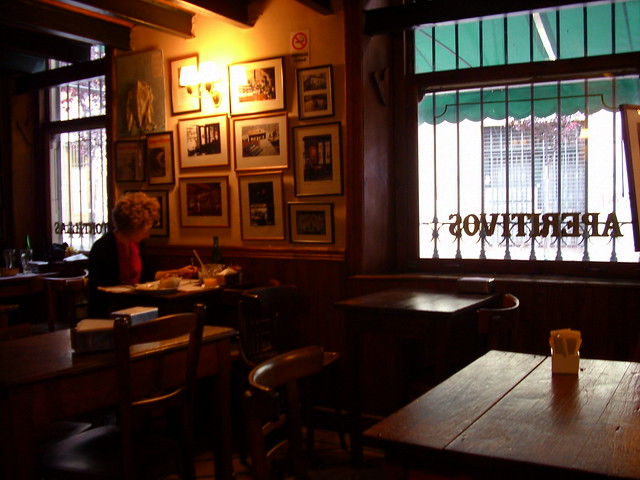
Photo by me, at a café in Monserrat neighbourhood http://www.flickr.com/photos/yet-one-more-pic/5351561825/

If you get the habit of speaking, shaping your thoughts and revealing the process online as a natural thing to do (i.e you blog), then, only then, I think something magical happens. There is a you that exists (or was born) online and that not all of the people in your face to face world know about. More dramatically put, they wouldn't care to know about. In a previous post on identity I framed the question in a way my friends Alan and David have considered significant.
"Let me ask you once again: Who are you when you write online? Think of it conversely. The offline-only people in your lives who have never ever cared to read what you passionately write about, who do they actually know?"
Don't get me wrong. Don't rule out the f2f people who would not read your blog! Go inwards and ask yourself where you choose to reveal what and how to imbue each space you live in with the nature you've acquired in the other.

There you have some learning exercise to spend a lifetime to master.

Labels: , , , , , , ,

Saturday, March 24, 2012

Identity Revisited


I won't play around this. So let me say it straight: I simply want you to watch this 15' video.


If you don't have the time, or rather, you *think* you don't, then read my post,which is loaded with the hope you will watch that video later.

The story goes back to 2007, but given the fragmentary nature of snippets of writing spread all over the Internet, I am confident to say that this post could well make sense without too much background.

What is more, it could even be worth it without a reader. I actually write this to make sense of my fledgeling thoughts around the experience of meeting people online.

If I had to be precise, I would say it was Alan's post linking to my post where we truly first met (see comments there). What happened to me the day I read his post was very similar to what happens to me now after watching that video.

At the same time, the immediate reaction after watching it was a mental link to a lesson I taught the day before yesterday as well as something I've read in the (online) paper this morning.

The image of one of my students came to mind as I watched. He has heard me speaking in class about RSS readers and blogging and tweeting making email quite a basic and moderate technology compared to all that powerful combo. You can imagine what I was talking about, but the point is his eyes and body language were showing uneasiness until he bursted:

"Oh you are a geek. I hate social networks".

The evangelizer in me was about to go on a rage of passionate thoughts about my online experiences, but fortunately I said nothing there and then. After all, my student had already declared war to Internet possibilities without any prior experience -good or bad or indifferent- to account for it.

Why my link to all this? Because I wonder about the people who do not share the same experiences of the web. People who have never read and felt deeply moved by Jabiz or Gardner also mentioned in the video. What do they understand from Alan's keynote?

What I wonder is, can meaning be made without a prior connection to those people mentioned there? I am sure the intended audience of the video -the Flat Classroom people- already have an idea of who Alan is, probably they've read a post or two of his and heard wonders about him from Vicky and Julie.

Probably someone is now clicking on my blog, not because I am who I am, but because I am who I became for Alan, whom they "know" already.

Two sides to this coin: how to express this concept of Digital Selves and how to grasp it.

Whenever I need to teach (whatever that entails) any skeptical student about being yourself online, I am faced with that feeling of being in a prison I'd call "wordless". Talking about these elusive concepts emerging from my online experiences, I know I simply go around the idea, but I do not always hit it. On the other hand, I am glad there are good storytellers out there who can summarize it in 15 minutes of video, from the experience of loss and receiving my email to the concept of a Personal Cyberinfrastructure. As you can guess, that's not an easy story to tell. Talk about literacy.

I said my thoughts also linked to the paper this morning. I read an article about the Malvinas/Falkland conflict. There was an online, perhaps via Skype, communication from a bar in Buenos Aires with another bar on the Islands. People, not governmental authorities, but ordinary people voiced their feelings about the most controversial issues around the conflict. In spite of the tension of the dialogue, some agreed both our cultures love spending time with friends at a pub. An Argentinean war veteran sympathized with a woman who lost her husband in the 1982 war as she still feels hurt. Neither of them knows the feelings at that moment had been foreshadowed by Thomas Hardy's poem long ago:
"Yes, quaint and curious war is!
You shoot a fellow down
You'd treat, if met where any bar is,
Or help to half a crown."

Would a war have taken place if people had been able to talk online like this 30 years ago? A participant in that conversation said that it will be difficult to solve the conflict while there are people who remember the war, who suffered the consequences and have too many emotions around it. It'll take new generations freer from the pain to really have some dialogue. And that's what I link to my feelings after the video. Alan made me play a big role in his story. I am so moved I write this right after watching -still exploring my thoughts about it. So how can I be the one to have distance enough to make sense of this for the audience of my blog or for my students? Can I? Really?

It seems incomprehensible for those who dread the idea of being online. But then again, Nicholas, who is online, is far too negative about it.

I'll try.

A bit of fresh air


After watching the video today I felt something very similar to what I had felt when I first read/met Alan. It was the first link to my blog, I think. Definitely the first meaningful link. Because Alan had expressed how my idea triggered his thoughts and he developed it with a graph and all. I thought: he is teaching me what blogging means. There is a learning conversation starting here. This is good.

But now, five years on, I see that he was not just modeling what blogging means. He was reiforcing a blogging direction I had already taken. I was *becoming* a blogger. And this is the point: One thing is to simply read and get informed, perhaps learn something, and quite another is to become, to expand who you are. To revisit your identity.

Yes, quaint and curious the Internet is.

How else could it have happened? I mean, I had been reading blogs and seeing people linking to each other by then for sure. Yet that had been reading, not becoming. Blogging can be a loss of time to the outsiders while it feels perfect time spent to the bloggers. It's magic. We are so positive about it, but blogging just doesn't happen unless you make friends, folks.

We are who we are because of those people who care to read and react, let their hearts rage a little with your words and then -this is key- they *do* something about it. Maybe write a blog post, tweet, shoot a photo or edit a video. Even if they feel overwhelmed by your words, they do not comment as fans, but as friends sitting with you at the same coffee place. Only then you can go back to writing emails that make more sense that the ones you used to write before these open writing experiences.

I am so grateful to every reader who has been touched by my words. My voice, my digital self reaching out here to you has grown on echoes of all of them. There are so many potential friendships out there. It's just so much more than I can express.

So do go and watch that video, OK?

It's a video in which I have had the surprise of unexpectedly meeting face to face with a meaningful part of who I am.


Labels: , , , , , , , ,

Thursday, September 01, 2011

Some thoughts on identity -particularly mine


I have never written posts like this or this. Come to think of it, I wonder what people think of me when they probably have little data about my offline life and self. It sometimes feels unbalanced that I know so much about them.

Who are we when we are online?

Maybe a better question could be,

What is it about you that surfaces in an online environment and would not come up anywhere else?

Things change depending on how you frame the question, don't you think? The first question seems to call for a battle of opposites between virtual and real. The second question could well ignore superficial dualities and deal with more important things, in my opinion.

I think it is not possible to hide who you are after having written for, say, four years online. If you pretend, I think you may fool a beginner, someone who goes for convenient quotables in your posts instead of consistency. Because reading, after all, is a choice between what you would like it to mean and what it actually means, seasoned with lots of tolerance for what you cannot tell clearly yet.

I think I need uncle Whitman to help me express what I mean,

"All truths wait in all things,
They neither hasten their own delivery nor resist it,
They do not need the obstetric forceps of the surgeon,
The insignificant is as big to me as any,
(What is less or more than a touch)..."#1

Things are there, if you want to read them. That simple.

Those who have been reading my tweets or listened to my mini-podcasts know that I love poetry and poetic prose fragments. You may find the most varied kind of poems there in English and in Spanish, but I know that there is an underlying theme in my choices. My search, my drive in finding them is an exploration of how different voices have managed the struggle of making sense of the world, while living in touch with the mysterious interstices between fantasy and reality.

So, for instance, for Borges, reality and dreams are really hard to tell from each other. His point of view is that of Leo Di Caprio's in Inception. (By the way, I learnt that the film director read a lot from Borges before writing the script).

Cortázar, far from the academic and classical allusions so typical in Borges, made his point speaking of objects that surround us everyday. Listen to him,

"Now I write birds.
I do not see them come, I do not choose them.
They are suddenly there, they are this.
A swarm of words
perching
one
by
one
in the barbed wire of the page,
screeching, pecking, rain of wings
and me, without any bread left to give them, just
letting them come. Maybe
that's a tree
or perhaps
love." #2

Cortázar is an ordinary man with an extraordinary predisposition to weave poetry with whatever signals he comes across. He is a feeler, a noticer, a dailyshooter.

When asked about where he drew the line between reality and 'the fantastic', as the genre he wrote in is called, he said:
"I don't. The fantastic is my reality."#3

Try it.

Juan José Saer, who would have probably argued with Borges, solved the reality versus fictional aspect of literature quite simply:
"By its mere existence, every story is real". #4

On a TV interview #5, Saer was asked to talk about the power of books, their relationship to life; he interrupted the interviewer and said:
"Books ARE life."

Those words go deep in the vinyl of my brain.

We are, we live, we can understand based on the many stories that were read to us, and the countless stories we have told ourselves of who we are.

Think of this.

When you write, and you try to be transparent about how each fledgeling thought of yours is tied to the words that another blogger has said, and you become aware of the hyperlinks between their experiences and your own life story, isn't that as real as it gets?

Right. No. How about close-up enough then?

How can I hide who I am in my choice of subjects for a photo, in my foreign tone of voice when I read a poem, in the rhythm of my sentences or the list of subjects that never ever get an account of in my blog? Something real and undeniable underpins the chaos of it all.

But.

You do not have my portrait. You hardly have a clue of how old I am. You cannot read my very own poems sleeping in a cardboard box on the bottom shelf. Most importantly, you do not know who I'd be ready to kill or die for.

I have long ago decided all that is my privacy.

And yet, I like to think that if you, keen reader of my online footprints, met me face to face, you would confirm you already know me. You would, perhaps, just add more accurate sources to this long quote of myself, which is my blog.

Let me ask you once again:
Who are you when you write online?

Think of it conversely. The offline-only people in your lives who have never ever cared to read what you passionately write about, who do they actually know?

I feel I could carry on writing like this, but this post is long enough and I need some sleep.


Notes:
#1 Whitman in Songs of Myself.

#2 Cortazar's fragment is from the poem "Cinco últimos poemas para Cris". The translation is mine.

I
Ahora escribo pájaros.
No los veo venir, no los elijo,
de golpe están ahí, son esto,
una bandada de palabras
posándose
una
a
una
en los alambres de la página,
chirriando, picoteando, lluvia de alas
y yo sin pan que darles, solamente
dejándolos venir. Tal vez
sea eso un árbol
o tal vez
el amor.

#3 My best recall of what Cortázar says in this long interview.
#4 Juan José Saer in his novel, La pesquisa (The Inquiry). I read a taste of it here.
#5 How I wish that existed somewhere online! It was in Channel 7 in early 2001.


Labels: , ,

Links

Meta

Visits since July 2006:

Copyright ©2006-2025. Claudia Ceraso. All rights reserved.
  • My Blogger Profile
  • Subscribe to this blog's feed
    [What is this?]