Wednesday, September 21, 2011

What I've Learnt with the Dailyshoot

As much as I love photography, it hasn't crossed my mind to go to a formal course. Maybe not yet. But with the wealth of information online and my enthusiasm to explore on my own I don't see room for a formal course in the near future.

I have been shooting photographs every day for about 300 days now. Following the Dailyshoot prompts has given me some pleasant surprises. I have learnt quite a lot informally and I think it is a good idea to continue documenting it. Here is an illustrated summary of my photo discoveries.


-If I let go of the picture I have set out to find, the one right in front of me may be even better than what I had imagined.

Pietà


-Overdoing it doesn't always render a better shot. The first one may be your best one.

Tree Parade

-Prompts make me take pictures I woudn't otherwise have taken.

Circles of Delusion
-It's a good idea to priorize fluency over accuracy. Do it fast. It's not about the best shot ever, but a fair enough shot. Play on. You'll take another one tomorrow.

Ride

-The photographer is more important than the camera. People do incredible things with an iPhone. I don't have an equipment with plenty of options. So I tend to get more carried away by composition than by technical aspects of aperture, focus and overall quality of the photo.

Shine


-Think light, then shoot. Even when you've found the cutest photo subject.

Amigos

-Be there. Your photo can be in that place you walk by every every day. Notice the details.
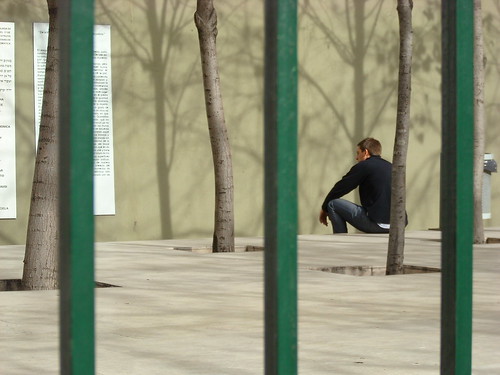
Thoughts

-The trivial is as good a photo subject as a work of art. Shooting daily, you learn to photograph anything in front of you. Point of view does it.


Remotely Viewed

Re-reading what I just wrote, I find it sounds a bit like rules. I do not know if there are rules to learn informally. Certainly there are patterns shaping in what I do. Experimenting daily you find beliefs about learning emerging quickly. This post is about jotting down those ideas before they are challenged by future learning. This is what works for me now.

I do have one rule. One rule only I am sure to follow: keep it up.


Labels: , ,

Sunday, May 23, 2010

Learning Dimensions


Some ideas around the social, the private and other learning lands. I am just trying to understand these concepts by spotting intersections with Connectivism. This is a remix of notes I left out of my previous post, Social Learning.


Take the notion of space and combine it with learning. Informal learning can occur in a variety of places. Incidentally, learning may happen with a teacher, without a teacher or in spite of a teacher. Formal learning happens when there is a school structure acting as an architect of a learning space. Yet, informal learning can take place in a university and formal learning can be seen in a social network. What does this depend on? Perhaps on the readiness to identify marginally relevant conversations in a classroom (residual knowledge). Perhaps some recognition that some instances of learning with networks we come across on the web are nothing but old things in a new medium.

Now take the social ingredient and add it to the learning soup. Social as the people factor. Social as someone who can be friendly with us should we need to pick their brains. Mind you, not your friends who like you or friends of a friend who send requests, but an ever shifting node in the network that can help you learn wherever your drive takes you in your knowledge quest. It may seem that the world is a small town. It does not matter if the node is six degrees away. It's not as much about access as it is about diversity of contribution.

How does this work?
One node at a time. At a learning ripe time. To me, the node is not there to simply share what they know or show you how they have been learning, but to learn together with you. Not social because they pressed publish to their thoughts. Not just transparent about their processes and sources. People learning right there and then, as a natural consequence of the connection and its current conversations. Something like "I can't help learning from you because you learn here and now with me".

This kind of learning timing does not seem to be liable to scheduling. It goes beyond having learning interests in common. I find it closer to personal values and attitudes to nodes and the learning process itself.

Now season it all with the Internet and what do you get?
Acceleration. Sparks. Too much to read in your RSS. Suddenly you affirm digital learning is different. Is the internal learning process (not the observable outcome) really different? Or is the digital dimension more clearly revealing or confronting us with the way genuine, long lasting learning has always been?

Think of a traditional classroom. Imagine students unable to interrupt a teacher's lecture and no mobile phone distractions. Then listen to teachers affirming that what is going on in there is knowledge transmission. Would you, digital citizen, say that the learning which may have resulted in such classrooms was due to transmission? Learning has probably never been too different. What has changed is perspective and description.

Digital learning spaces are providing new evidence. Learning is more complex than our preconceptions. The social and the space are the context of learning. Learning can happen outside context. Hard to keep in a cage called formal or informal. Is learning voluntary or involuntary? Not every student learns the same in one given classroom. Learning revolves around togetherness and individuality. Togetherness is ruled by social context and degree of synchronicity (same place, same time). Individuality is ruled by personal relevance.

Maybe the distinction between formal and informal learning is misleading. Informal learning examples are probably the evidence that formality in education is a fiction. A learning tale. I am not saying I have not learnt anything in a class. All I am trying to say is: what if it was not because of that class? Description as explanation is insufficient.

I see a lot of metonym talk around. The tool as an umbrella term for the venue, process and outcomes. Stretching an idea of learning, surpassing it or destroying it. Learning is not in the tool, but in its shadow.

Far from objective facts, my reality and truth about learning will spring from my unique perceptions and interpretations. To me, learning is experienced as social during conversations. That's how I feel it. However, our perceptions, as Dr. Carl Sagan teaches us, are somewhat limited:


Frankly, I find that most of us work on the outskirts of a true learning land. What we know is not automatically in sync with what we do. It makes me wonder whether authentic learning entails some disrespect for our most cherished illusions about difficulty grading, linearity of syllabus and hierarchies. The world is flat, we say. We are flat landers, busy building our flat classroom business, projecting our models on the dimension of learning spaces for our own individual purposes.

Labels: , , , , , ,

Links

Meta

Visits since July 2006:

Copyright ©2006-2025. Claudia Ceraso. All rights reserved.
  • My Blogger Profile
  • Subscribe to this blog's feed
    [What is this?]