Saturday, September 24, 2011

Should've Known Better

This year I've made a point of quitting the use of the word 'should'. Seven months into the experiment, I can (almost) safely say it is now gone. Gone from my blog, from my everyday vocabulary. Above all, gone from my inner thoughts.

Why? How did I start this?
Because whenever I read that teachers should...(you fill in the blank)..., I've always felt a need to resist inside instead of engaging in conversation.

Coming closer to examples, I think we mean different things when we use 'should'.

Generally speaking, in affirmative form, I think it sounds like a disguised form of protest.
e.g. "Every teacher should blog".
Which probably translates to "I would like, I need, it would be nice if... I do, it works for me, why not you? Come on!"

Speaking more personally, it's a bit of a diminishing word.
e.g. "I should blog every day."
Which may well translate as: "I think that my not blogging everyday is not enough" or "I wonder if I ever will". These phrases invite to approval or disapproval. A pass or fail in a test. (Who needs another test, anyway?).

I could go on. A quick search in my RSS reader gives me inspiration, but I won't quote. You go search for yourself and write your own subtitles to the 'should' movie. There is a lot in need of translation written out there.

'Should' works very well in question form, though:

"Why should I believe that?"

See? That's the kind of blogging I want to read on without feeling an internal argument building up inside me to resist it. It engages me to find my own reasons. I may even blog back at you. So we both get a chance to learn.

The mind has a natural tendency to resist change at times. if you mean to create or lead change when you write, watch your use of 'should'.

I hear the word very frequently in my network; I do not stop reading people who use it. I just read between the lines knowing I cannot assume what they really meant until I read much more.

Excuse me for contradicting myself in the same post, but I don't think anyone should anything, be it change the way they teach or publish their minds in blog posts, until they find their own genuine reasons. Anything else is as attractive as thoughtless cut&paste of ideas.

About writing, I think that there are more powerful words than 'should'. Only the sentences need to be more wordy, you need to go meta reflective to create meaning, you need to put yourself out there in the open.

How? Here's a possible structure:
"I would like this to change because..." Paragraph. Concise.
Followed by,
"I shape my thoughts like this because of where I come from". More paragraphs. These are key.

That's more humble and also less pretentious. Bonus: that's is the way I can get to connect to you. Speak from your known corner of the world to the unknown world wide web who might read and write responses, if they feel so inclined. Your ideology need not be photocopied elsewhere. Finland is already taken. Perhaps, we need to do differently.

If you ask me, I like sentences with a deep structure grammar based on freedom, not authority. Freedom from the critic or evangelizer lurking in your voice. Besides, 'should' is a poor authority invoker, in my opinion. It tends to overstep it.

So consider cutting down on affirmations with 'should', please. I'll see for myself what I might do with your thoughts, if anything at all.

Engage me. Show me your learning. I'd rather you tell me your stories.


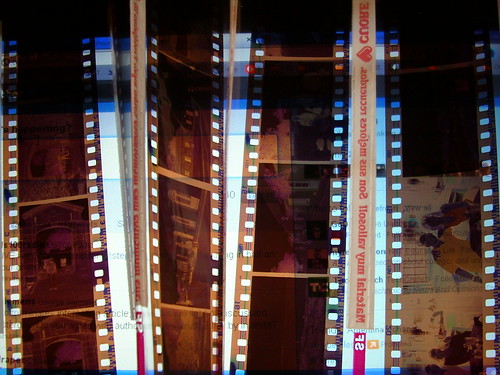
Time Long Past
Time Long Past, by me on Flickr

Labels: , , , ,

Sunday, September 18, 2011

Writing Phantoms

"It is impossible to say just what I mean!
But as if a magic lantern threw the nerves in patterns on a screen..."


Expressing yourself. Online. Making connections. Learning all along. That's the common denominator of what we are doing here.

But there are differences. Huge.

Daily Homework

What I enjoy about writing my thoughts online is that these posts give closure to a string of ideas and free me to turn onto things I had not considered before. Sometimes they are like a soup -cooking slowly and mingling what were merely ingredients, spin off ideas read in blog posts. This post has a network of ingredients.

My last post on identity made me realise that I write with a premise -or an illusion- of being understood. Actually it was Graham Wegner's comment that painted it quite clearly to me:

"Claudia, I'm never quite that confident that I have understood your intent in your blog posts, but I am confident enough to know that any written content is open to interpretation from the reader's perspective. Even text that is interpreted differently from the author's intent is valuable and pushes the reader to consider things from a new angle. And if they present those conclusions or ideas back to the original writer, it can open up new insight that wasn't originally considered. If all your readers understand perfectly what you are trying to say, then they may have nothing useful to add to the conversation!"

Interpretation is open source by nature. While my illusion of being understood probably springs from a genuine need, in a networked world, being misunderstood matters most.

Graham says more,

"Maybe in the online connected environment, we can bypass what is considered essential personal detail trading in the face-to-face world, and get down to the emptying of one's still embryonic concepts out to an unknown but open minded audience."

Hopefully someone will 'misunderstand' and leave thoughtful comments like these! And yet, we still long for those details. The unimportant things that make us human.

While slowly mentally drafting this post, making sense of my own need to be understood, David Truss alerted me of Amalia's post, Voice Found. Now What?.

There you have a voice struggling beyond whatever may be a stumbling block for me; for when I write, I completely trust a connection will be made. I simply don't see how it cannot. Unless I change my style to how-to manual writing mode. There's you out there. I know that for sure.

Amalia says,

"So, instead of saying that I’ve found my voice, the bigger truth is that I trust my voice. I know when I’m going wrong. My bones tell me. And if I can stay true to that, then I’ve done something. The problem now is choosing what to say. There are so many things I’m passionate about..."

Her need is different from mine,

"This blog is forcing me to choose. Well, let me put it this way. For the sake of a sense of community around my blog, I want to focus a bit more. Even if it’s only me and two other people, I want us to chew on some common topic together. (...) Show me what You want me to do with this voice. I want to be useful, I want to harmonize, I want to connect."

The post left me wondering and with a strange sense of sadness. I think it's important to find a voice, but it's not enough. Now I see it differently. I'm afraid I disagree with Amalia. The problem is not choosing what to say. The problem is trusting yourself enough to stand at the edge of the writing cliff and make a bungee-jumping leap of faith. Trust your voice to be neither right nor wrong. Connections? That's the easy part: they are the inevitable consequence of sharing your-self.

I am reminded of a lecture by Virginia Woolf: Professions for Women. Fifteen years ago, I would read that lecture voraciously.

Flashback. I remember a bicycle going by in front of Cambridge University on a cold January, sunset, organs playing -one clear, another one fading-, the walls looking like sepia-toned photographs. Me, walking and holding a copy of A Room of One's Own next to my heart. I was planning to buy a flat of my own in Buenos Aires, to be free of paying a rent forever. Maybe write. The Internet was not a dream yet.

I hear Virginia again. (Are you still reading me, Amanda?).

"While I was writing this review, I discovered that if I were going to review books I should need to do battle with a certain phantom. And the phantom was a woman, and when I came to know her better I called her after the heroine of a famous poem, The Angel in the House. It was she who used to come between me and my paper when I was writing reviews. It was she who bothered me and wasted my time and so tormented me that at last I killed her. You who come of a younger and happier generation may not have heard of her--you may not know what I mean by the Angel in the House. I will describe her as shortly as I can. She was intensely sympathetic. She was immensely charming. She was utterly unselfish. She excelled in the difficult arts of family life. She sacrificed herself daily (...)

I turned upon her and caught her by the throat. I did my best to kill her. My excuse, if I were to be had up in a court of law, would be that I acted in self-defence. Had I not killed her she would have killed me. She would have plucked the heart out of my writing. For, as I found, directly I put pen to paper, you cannot review even a novel without having a mind of your own, without expressing what you think to be the truth about human relations, morality, sex."(...)

Thus, whenever I felt the shadow of her wing or the radiance of her halo upon my page, I took up the inkpot and flung it at her. She died hard. Her fictitious nature was of great assistance to her. It is far harder to kill a phantom than a reality. She was always creeping back when I thought I had despatched her. Though I flatter myself that I killed her in the end, the struggle was severe; it took much time that had better have been spent upon learning Greek grammar; or in roaming the world in search of adventures. But it was a real experience; it was an experience that was bound to befall all women writers at that time."

At that time? The lecture was written in 1931. The phantom was the impediment to say exactly what you think while being a woman in a man-writer's world. I could harry to say that the 21st century is different, that there are no such gender differences; however, I think we do have phantoms lurking.

I still see it is more likely for women to take care of the home than become prolific bloggers. I still find men more straightforward and less puzzled by dichotomies of online vs offline identity. Less concerned with having to open different blogs because they found new topics of conversation, which may cause worries about losing audience or clicks. I may well be over-generalizing, but men are more likely to be beyond all that. They would probably not write a post like this one. Or take as long as I take to write it!

I had a Skype call with my friend Alan Levine recently. A first synchronous talk after years of connecting online. I remember Alan told me about how he writes. He needs to get it said and published. He is fluent about blogging. I don't imagine too many drafts sleeping in his blog editor.

Alan left this comment on my previous post,

"We talk about 'going' online like it is a place, we never talk about other media like that. And given the way mobile connectivity enabled the communication, I hardly see my online and not online modes as being so cleanly split.

I exist as one Alan: there are things I don't put online but I do not see a neat division."

Perfect.

We are all sharing, connecting, learning. There are interesting differences, though. Amanda is struggling with the phantom of connecting; I am struggling with one of elusive expression. Meanwhile, Alan is being himself.

You need to find your voice and your purpose. And then, not to be tongue-trapped by anything. There's some learning job, if you are patient. After that, there is the most difficult of all. To react genuinely to every single blog post that stirs your mind, to every agreement or deep disagreement with the closest people in your network. For that, you'll probably have to learn to kill a few phantoms. Even when you think you have mastered that exercise, it would not be surprising to find yourself again back to square one in the network game.

Note to Self
Remember the basics: never ever assume you're that connected, well- expressed or understood.

Now make that as big or small as you want.

Carry on.


Labels: , , , ,

Sunday, February 06, 2011

On Connections and Vulnerability

Last week I came accross this post with a TED Talk video by Dr Brené Brown. The talk is really a good way of spending 20 minutes of your time. Jabiz Raisdana got inspired (although I wonder when he is *not* inspired) and created a mashup with the sound of Brené's voice.

This is my response to his post.


I saw the video a few days ago and it still haunts me. I really like how her research and passion for it made her come to a crossroads in her life: the need to take a good look inside yourself before you attempt to make sense of the world. I think that is what we all do when our jobs are more than a means to make a living. For me, teaching is the viewpoint to grow in my life. It's the car I've chosen to do my journey.

But I digress from your post. Back to connections.

I've been thinking that sometimes the passion that makes us share has a blinding force as well. I think we are online to obtain not a just a connection, but its so desired effect. It's as if connections were a means to something, which is so difficult to describe and so distinctly personal that, for simplicity's sake, let's call it connection, or openness or sharing. I think those words are the underpinning grammar of learning magic.

The mash-up you made is like an entry to your mind making connections. It's so much more than "yeah, I love the talk". As I listened, I felt as if you had heard another TED talk. I was wondering if you had picked up the same traces that made me like it. Probably not. However, you left towards the end the line that sums it all up for me: 'our imperfections make us beautiful'.

We cannot take for granted that we all mean the same by sharing and being open. I think that most of us who have edublogs have the shared experience of not having had these dialogues so fluently or frequently in our f2f contexts. Finding interlocutors is the only way to grow, so here we are making connections, which are crucial to our learning. As much as it still surprises me that here I am in Buenos Aires talking to you -who must be sleeping- in Jakarta, I'd like go past the being wowed to move on to the topic of genuine connections.

I'm quite sure I don't get sharing and remixing the way you do. I don't think I would feel inclined to try to produce something like this in future. And you know what? It's not necessary. I'm here because somewhere in a stream of tweeted and blogged thoughts I felt quite at home in what you say. That prior connection makes me curious and willing to understand where you come from to mashup like this. I don't intend to find similarities. I'm not scared we may disagree either.

I think that many bloggers try to find sameness and then get their sensibilities tied up in offence. But validation seeking, though necessary, doesn't make us grow. That's not what openness looks like to me. I think we need to connect to go beyond the hype, the passion and look for something more profound. It's easy to pick up the jargon, the talk of technology in education and blog it out loud. We need to have the skill to tell the validation seekers from the genuine sharers. There are many more blogs today, but it's still hard to collect many more examples and models, let alone new meaningful connections.

I still read and comment in the same blogs. Writing hasn't become any easier for me. I spend a long, long time to produce a post. My teaching, what I do in class, has probably not changed that much outwordly, but it feels different for me and I see its effectiveness when my students get that discovery look in their eyes. How can that be assessed?

Vulnerability is not something I'm good at. Hence the many drafts posts I've written that have never seen the light. Sometimes I feel I cannot express it clearly, sometimes I don't know if, by passionately disagreeing, I disappoint people in my closer circle of connections who may have taken for granted my views. The point is that when I sense we can share enough core values, I need to disagree with you. Not in a reactive way, mind you, I think it's part of identity building.

You see, I reread this and I don't think it makes any sense. And if it did, again, it's so easy to misunderstand. It's (oh) so difficult to know another person. It's so tempting to assume we have found likeminds. It's scarily normal to close doors when we find differences. Yet I think that what we do with all those differences in the middle of so much shared ground is the learning that matters most.

A few lines from John Donne come to mind now,

"Our two souls therefore, which are one,
Though I must go, endure not yet
A breach, but an expansion,
Like gold to aery thinness beat."

If we could remain calm when the truth as expressed by our online friends does not match our illusions. If we could embrace the differences and strengthen the connection from there -without any need to call it literacy or hasten to shout that technology enabled it. Maybe we can leave technology in the back seat and drive ourselves with the self-reliance that empowers us to judge a sour face exhibiting little understanding and go for it anyway.


Thank you for triggering this Jabiz.

Labels: , , ,

Links

Meta

Visits since July 2006:

Copyright ©2006-2025. Claudia Ceraso. All rights reserved.
  • My Blogger Profile
  • Subscribe to this blog's feed
    [What is this?]