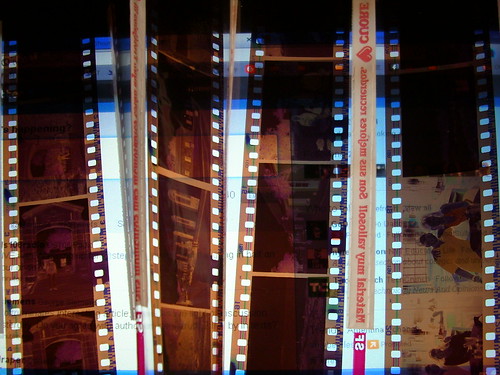
Saturday, March 24, 2012

Identity Revisited


I won't play around this. So let me say it straight: I simply want you to watch this 15' video.


If you don't have the time, or rather, you *think* you don't, then read my post,which is loaded with the hope you will watch that video later.

The story goes back to 2007, but given the fragmentary nature of snippets of writing spread all over the Internet, I am confident to say that this post could well make sense without too much background.

What is more, it could even be worth it without a reader. I actually write this to make sense of my fledgeling thoughts around the experience of meeting people online.

If I had to be precise, I would say it was Alan's post linking to my post where we truly first met (see comments there). What happened to me the day I read his post was very similar to what happens to me now after watching that video.

At the same time, the immediate reaction after watching it was a mental link to a lesson I taught the day before yesterday as well as something I've read in the (online) paper this morning.

The image of one of my students came to mind as I watched. He has heard me speaking in class about RSS readers and blogging and tweeting making email quite a basic and moderate technology compared to all that powerful combo. You can imagine what I was talking about, but the point is his eyes and body language were showing uneasiness until he bursted:

"Oh you are a geek. I hate social networks".

The evangelizer in me was about to go on a rage of passionate thoughts about my online experiences, but fortunately I said nothing there and then. After all, my student had already declared war to Internet possibilities without any prior experience -good or bad or indifferent- to account for it.

Why my link to all this? Because I wonder about the people who do not share the same experiences of the web. People who have never read and felt deeply moved by Jabiz or Gardner also mentioned in the video. What do they understand from Alan's keynote?

What I wonder is, can meaning be made without a prior connection to those people mentioned there? I am sure the intended audience of the video -the Flat Classroom people- already have an idea of who Alan is, probably they've read a post or two of his and heard wonders about him from Vicky and Julie.

Probably someone is now clicking on my blog, not because I am who I am, but because I am who I became for Alan, whom they "know" already.

Two sides to this coin: how to express this concept of Digital Selves and how to grasp it.

Whenever I need to teach (whatever that entails) any skeptical student about being yourself online, I am faced with that feeling of being in a prison I'd call "wordless". Talking about these elusive concepts emerging from my online experiences, I know I simply go around the idea, but I do not always hit it. On the other hand, I am glad there are good storytellers out there who can summarize it in 15 minutes of video, from the experience of loss and receiving my email to the concept of a Personal Cyberinfrastructure. As you can guess, that's not an easy story to tell. Talk about literacy.

I said my thoughts also linked to the paper this morning. I read an article about the Malvinas/Falkland conflict. There was an online, perhaps via Skype, communication from a bar in Buenos Aires with another bar on the Islands. People, not governmental authorities, but ordinary people voiced their feelings about the most controversial issues around the conflict. In spite of the tension of the dialogue, some agreed both our cultures love spending time with friends at a pub. An Argentinean war veteran sympathized with a woman who lost her husband in the 1982 war as she still feels hurt. Neither of them knows the feelings at that moment had been foreshadowed by Thomas Hardy's poem long ago:
"Yes, quaint and curious war is!
You shoot a fellow down
You'd treat, if met where any bar is,
Or help to half a crown."

Would a war have taken place if people had been able to talk online like this 30 years ago? A participant in that conversation said that it will be difficult to solve the conflict while there are people who remember the war, who suffered the consequences and have too many emotions around it. It'll take new generations freer from the pain to really have some dialogue. And that's what I link to my feelings after the video. Alan made me play a big role in his story. I am so moved I write this right after watching -still exploring my thoughts about it. So how can I be the one to have distance enough to make sense of this for the audience of my blog or for my students? Can I? Really?

It seems incomprehensible for those who dread the idea of being online. But then again, Nicholas, who is online, is far too negative about it.

I'll try.

A bit of fresh air


After watching the video today I felt something very similar to what I had felt when I first read/met Alan. It was the first link to my blog, I think. Definitely the first meaningful link. Because Alan had expressed how my idea triggered his thoughts and he developed it with a graph and all. I thought: he is teaching me what blogging means. There is a learning conversation starting here. This is good.

But now, five years on, I see that he was not just modeling what blogging means. He was reiforcing a blogging direction I had already taken. I was *becoming* a blogger. And this is the point: One thing is to simply read and get informed, perhaps learn something, and quite another is to become, to expand who you are. To revisit your identity.

Yes, quaint and curious the Internet is.

How else could it have happened? I mean, I had been reading blogs and seeing people linking to each other by then for sure. Yet that had been reading, not becoming. Blogging can be a loss of time to the outsiders while it feels perfect time spent to the bloggers. It's magic. We are so positive about it, but blogging just doesn't happen unless you make friends, folks.

We are who we are because of those people who care to read and react, let their hearts rage a little with your words and then -this is key- they *do* something about it. Maybe write a blog post, tweet, shoot a photo or edit a video. Even if they feel overwhelmed by your words, they do not comment as fans, but as friends sitting with you at the same coffee place. Only then you can go back to writing emails that make more sense that the ones you used to write before these open writing experiences.

I am so grateful to every reader who has been touched by my words. My voice, my digital self reaching out here to you has grown on echoes of all of them. There are so many potential friendships out there. It's just so much more than I can express.

So do go and watch that video, OK?

It's a video in which I have had the surprise of unexpectedly meeting face to face with a meaningful part of who I am.


Labels: , , , , , , , ,

Saturday, September 24, 2011

Should've Known Better

This year I've made a point of quitting the use of the word 'should'. Seven months into the experiment, I can (almost) safely say it is now gone. Gone from my blog, from my everyday vocabulary. Above all, gone from my inner thoughts.

Why? How did I start this?
Because whenever I read that teachers should...(you fill in the blank)..., I've always felt a need to resist inside instead of engaging in conversation.

Coming closer to examples, I think we mean different things when we use 'should'.

Generally speaking, in affirmative form, I think it sounds like a disguised form of protest.
e.g. "Every teacher should blog".
Which probably translates to "I would like, I need, it would be nice if... I do, it works for me, why not you? Come on!"

Speaking more personally, it's a bit of a diminishing word.
e.g. "I should blog every day."
Which may well translate as: "I think that my not blogging everyday is not enough" or "I wonder if I ever will". These phrases invite to approval or disapproval. A pass or fail in a test. (Who needs another test, anyway?).

I could go on. A quick search in my RSS reader gives me inspiration, but I won't quote. You go search for yourself and write your own subtitles to the 'should' movie. There is a lot in need of translation written out there.

'Should' works very well in question form, though:

"Why should I believe that?"

See? That's the kind of blogging I want to read on without feeling an internal argument building up inside me to resist it. It engages me to find my own reasons. I may even blog back at you. So we both get a chance to learn.

The mind has a natural tendency to resist change at times. if you mean to create or lead change when you write, watch your use of 'should'.

I hear the word very frequently in my network; I do not stop reading people who use it. I just read between the lines knowing I cannot assume what they really meant until I read much more.

Excuse me for contradicting myself in the same post, but I don't think anyone should anything, be it change the way they teach or publish their minds in blog posts, until they find their own genuine reasons. Anything else is as attractive as thoughtless cut&paste of ideas.

About writing, I think that there are more powerful words than 'should'. Only the sentences need to be more wordy, you need to go meta reflective to create meaning, you need to put yourself out there in the open.

How? Here's a possible structure:
"I would like this to change because..." Paragraph. Concise.
Followed by,
"I shape my thoughts like this because of where I come from". More paragraphs. These are key.

That's more humble and also less pretentious. Bonus: that's is the way I can get to connect to you. Speak from your known corner of the world to the unknown world wide web who might read and write responses, if they feel so inclined. Your ideology need not be photocopied elsewhere. Finland is already taken. Perhaps, we need to do differently.

If you ask me, I like sentences with a deep structure grammar based on freedom, not authority. Freedom from the critic or evangelizer lurking in your voice. Besides, 'should' is a poor authority invoker, in my opinion. It tends to overstep it.

So consider cutting down on affirmations with 'should', please. I'll see for myself what I might do with your thoughts, if anything at all.

Engage me. Show me your learning. I'd rather you tell me your stories.


Time Long Past
Time Long Past, by me on Flickr

Labels: , , , ,

Saturday, September 11, 2010

A Talk around Language, Culture and Disagreement


This is a comment I left on Bud's blog today. I invite you to read both, the post and its rich comment thread.

Bud asks,

How do you work to make sure that you stay kind, but avoid a case of the “yeah, yeahs” whenever disagreement arises? Who’s helping you to be thoughtful in word and deed while keeping you kind?

This is a question that sometimes lurks behind my writings in this blog. In my answer to Bud, I am probably reminding myself of how I deal with those choices. Or how I best try to.

Anyway, it is never easy to be an individual with ideas that touch other people's sensitivity. We are all passionate about our learning, what we consider best for our students, what makes sense, what is useful and worth trying. Expressing yourself in a widely networked context can become a challenging thing. Is this an unavoidable part of our teaching job?

My comment

Dear Bud,

I’ve been a bit offline lately and had missed the tweets you quote here. First, let me tell you those tweets sound kind enough in Argentina. I belong to a culture where an excess of kindness is taken as irony, so most people tend to fall off the cliff of rudeness. This takes long hours to explain to my students. I never get tired of insisting that even if they use correct structures and vocabulary, cultural codes need to be mastered at the same pace. However, I read you and I still believe you *are* kind enough. Maybe because I live in another culture and I cannot escape fully; not even with a lifetime of foreign language learning, or 4 years of blogging to ‘travel’ -as one of my close friends has described the purpose of my writings.

I’ve been reading your tweets in the last few months and I do notice a change in you. What I see is your learning is making you spot small differences. You seem to treat sentences or tweets as a detective. I say this in a positive sense. I feel like-minded and learn from your different style. After so much edu-talking, we all see people remaining in the high-sounding words and not posting about what actually happens in their classrooms or how they get from A to Z without a mention of a B. You are going deeper into meaning and that is part of your research spirit (I’m biased because I follow your writings, I know, but this is how I see you).

Now you obviously love a search for truth. There’s no such thing as ‘one’ truth, but authenticity to what you believe to be true in the light of your learning so far is important. You also care and respect. I understand you want to show consistent actions with these ideas. I think that the difference will be in what you decide will be proof of your succeeding in all this.

To me, truth is not always nice to hear, yet I prefer it. With family and close friends I value more being patient than disagreeing immediately. I simply will not risk hurting, let alone lose those people. At work, I want to innovate and to make things better in the ways I can. Resistance to the new is part of my reality and I accept it. I pull away when it stresses me too much and devise a strategie to come back to the healthy discussion. Sadly, I know I will lose some people on the way. Some temporarily, some for good. But when being authentic and consistent can suddenly go to second place on the value scale, I feel the earth trembling around me with mistrust.

I know I can try to be kinder. Outcomes and other people’s feelings are beyond my control.

Apologies for the length of this comment. Thank you for opening your mind and letting us in.

All very best,

Claudia

Labels: , , , ,

Sunday, May 09, 2010

An Aside

Day: Friday evening, May 7th 2010.
Place: Colegio Las Cumbres, downtown Buenos Aires, Argentina.
Scene: Stephen Downes had just finished his informal talk with teachers. Everyone is walking about the room.

I just wanted to say thank you when a small talk started. The fueling ideas after attending the morning presentation, the engagement of the teachers debating how far to guide students was all there. Stephen said something about noticing the enthusiasm among us. He added it would be even more interesting if people disagreed with him at times.

I deliberately took that as an invitation to voice disagreement. I found myself unable to do so, though. My own mind was a bit clouded with so much f2f blog talk. I tried to explain to Stephen why I could not disagree yet. This is my best recall of what I said mixed with what I meant.

When I hear an idea explained concisely, articulately organized and backed up by effective domestic examples, I find it hard to disagree immediately. I simply know that I will have questions. Eventually, at a later moment of the day, or perhaps some other day, I will find the points where inconsistencies with my own thoughts will provoke a need to challenge both his message and my previous way of thinking. I cannot help needing more time for disagreement to happen.

There were underlying assumptions to why I felt a need to explain this to Stephen. I believe that Stephen is an expert blogger who does not share these thinking or writing time limitations. He has learned a kind of fluency of expression regardless of the writing conditions. He can protect his mind from a hectic airport and decide to write like this. I admire that capacity. Yet, that kind of admiration is something I will need to question. Particularly if I find myself using it as an excuse to limit my own writing capabilities.

I said to Stephen that today I listen to him and give him the benefit of the doubt. For now, I am just taking my mind on a ride towards the message. Then, I'll take a few steps back to think further. I will try to post reflections or questions here in my blog. Sometimes, I need to write my mind out before meeting the lecturer. I find it is a blogger's advantage to do so. To write the here and now of my thoughts saves them from being taken ashtray or buried forever by a new glittering idea. I think I write to save my personal fledgeling thoughts. What I do not write today, I will never write again. Ever.

By then, a few teachers had gathered to listen to this. Stephen looked at them and concluded: "This is what we do when we blog".

Since last Friday, the personal pronoun 'we' has taken on a new meaning.


Labels: , , , , , ,

Wednesday, September 23, 2009

Edubloggers Meta-conversation

Today I have been visiting new blogs and reflecting on the many stages of conversations coexisting in the edublogosphere. We are all teachers and using ICT. It seems to bind us all, but that is a quick surface structure conclusion. Sense is made with deep structure parameters: "tools and pedagogy". I need to see which side of the pendulum they are at. Reading in depth, reading the discourse styles, I begin to draw quick conclusions about where they stand in education.

There are people who are still discussing things that, to be honest, I feel they are so last century. I find it very difficult to engage or say something to those posts. Shall I say: read this tag in my delicious? Provide links to the many posts that have already pushed me ahead? Certainly not the way. I give up reading them.

However, it just dawned on me the value of those conversations. The possibility to see how we have been talking while pioneers were overhearing us. Finding the same crossroads of filter/digestion/production through someone else's viewpoint. Whatever it was that took us in one direction and not another may be more evident reading them than your own PLE blogs. It is not just that some people "get it" and some don't. It's the process of getting somewhere. I just realised the value of seeing the trail of thought being born again and again. Another chance to assess the quality of the decision making process.

Disagreement pushes my thinking back and forth again. I struggle to write just what I mean. Trying to verbalize passionate ideas puts their core values to the test. Decisions to be made beyond the borders of my comfort zone.


Labels: , , ,

Saturday, September 05, 2009

Content First, People Second

Tweeting is easy. Tracing how I got there is not. I'll give it a try.

Before I posted it, my mind was a whirlwind of messy tweet-length thoughts. Browsing blogs and conference announcements on 21st century skills with speakers who have never blogged but claim they 'get it' made me react in disagreement. Hence the post tone. This is the edited version.

An edublogger is not on an attention search. It's a learning search. I agree there is a bit of both, however, it makes a world of difference which one prevails. Of course you want to be read and you need an audience to spread your content. Up to there, it is simply a broadcasting quest. No learning yet.

If your blog visit counter soars, it only means you have built an interesting, visible conversation venue. Easy to tell because at that point, you will be contacted for all sorts of so-called collaboration offers. They just see what you can do for them. Funnily they may have never been inspired to post a single comment on your blog. If they did, they certainly always agreed. You see, attention is the web currency and you might give them some. Attention currency exchange does not equal networking or learning. Creating an attractive venue is a start. You are findable. Just that.

Learning awaits the node that builds network. The network does not revolve around a guru or star blogger. Although you might be inclined -at first sight- to affirm it is so. Seeing a long thread of comments in a high ranking edublog can give that impression.

Whatever makes a post or blog a gem is that blogger's ability to express what other people wish they could, but they can't. Yet. Or perhaps something you were sensing was important, but didn't have a name for it; therefore, no conversation dealing with the core issue had been built around it. A blogger may offer a playground of a post to imagine how we can think new ways of learning. I think many newbies have believed this is it about the blogging revolution. This is the kind of success we should be after. Owning the learning in your blog. Without comments on the post, it is still unidirectional. Close to what fascinates me about blogging, but not it.

Oddly enough, for those taking the conversation ahead, it is not countless visitors or comments what they are after. They are indeed making connections and exchanging Twitter trivia preferably with a closed or selected circle of people, but it is not because they are popular that they flock together. It's because they can all relate to the same topics of conversation. Therefore, rapport. Once those minds get in touch, they accept the kind of learning that occurs cannot happen in isolation. That is what makes the network continue paying attention to new ideas from those selected bloggers. Because it is the only sustainable way to learn informally. You know they are your best learning triggers. That's when learning sticks.

Learning nodes are special tweeple/people. These guys are not seeking ordinary learning, but brain-pulling learning experiences. No echoes or emotional bursts like "Amazing, great post, keep them coming" will engage them at all. It is the conversation going on. They need to find the key node for some push back to their ideas, not pleasing words from followers. If there is any high they are after it is the thrill coming from the learning itself.

So you write, you tag, you post. Twitter or blog or both. Just make it findable. To make your voice heard without a hyperlinked text, you'll have to be patient. For it takes patience to build your network of trusted sources, friendly reviewers of content that may circulate your words in a range of sharing options. Content will get to you by link or by network. Anything you mark as read in your reader is not lost forever if it is important. This web of ongoing educational possibilities re-tweets or saves again and again in your delicious network for you to step on it when your learning time is ripe.

Push, promote and email doesn't do it. Pulling the tag into your reader does the trick. I think that if any of my favourite bloggers started spamming their content in my email, I would stop paying attention. The protocol of the connection is constant choice to read or not. It cannot be forced.

How does all of that networked learning start to happen?

I think there is a simple structure:
Content first, people second.

For the newbie, this structure seems counter-intuitive. The newbie tends to crave for people to help them focus in an attempt to control the messy nature of the web. They want to search and quickly get to the list of 1001 best tools or the blog roll of the must-follow in education. They apply an old way in a new medium. The new way, instead, is opening up to finding value in randomness of diverse readings that lead to bloggers and, perhaps, connections. Serendipity is finding people through content. This is pure pulling power. It cannot be forced.

There is no right or wrong or best or fastest way to do it. I'd say it takes a couple of years to build a PLN. Once built, once it works for you, I find that you have to stop trying to search for connections. It is time lost that could be better spent blogging. Those nodes will appear as you join backchannels or blog posts. One day, you have to stop looking for learning to happen in a pushy way and let the flow of interactions in your network feed you the content.

As more people publish, what does the picture look like nowadays?
Educational technology is fashionable. I see misunderstandings on and offline.

We have to accept there will always be so-called experts talking about blogging who do not have a blog. If they haven't dipped their fingers into the pool, I guess I may be impressed at their performance, but not engaged. If they were truly committed, they would make their content findable. They would have piped their way to me through my RSS by now. How am I so confident? Because I am not looking for voices who need companies or institutions to make them seem reliable or specialists in the subject of informal learning. That is a marketing strategy that has no effect on me. Show me the content. Let people network around it.

Before hurrying into following popular people on blogs or twitter, it would be wiser to expose yourself to their content and see if some genuine resonance happens inside. Or not. You may be clueless why that blogger is so well networked. If tempted to approach them, you'll see it is fairly easy to attract the attention of any edublogger for a temporary exchange. It just takes a good amount of @messages or trackbacks. Problem is pushing doesn't build network.

The learning I am after is about depth. That takes a trail of thoughts sustained through a long time. If the connection lacks a foundation in content, it will fall like a castle of cards. It doesn't escalate. Content first, people second makes the difference. With a good connection built, it's irrelevant whether someone temporarily blogs about topics outside your interest area. Blog on. If you are engaged parts of the same conversation, content will pull you back together at some time.

Labels: , , , , , , , , , ,

Thursday, September 18, 2008

Cn EdubloggerCon Chat

Cn EdubloggerCon Chat

It's simple. You check what's going on via Twitter and if you feel like learning you join the conversation. That's how I joined this one tonight. It started in a
UStream channel by Jeff Utecht inspiring a lively conversation among some 20 followers, which ended up in a wiki that was read aloud to the the attendees. Full circle.

It's strange to think that so much learning and engagement goes on among people I've never met face to face. Of this online meet-up
I've just met Chrissy last summer in Buenos Aires. Yet, we are all happy learning buddies. Somebody will have to explain to me someday why these conversations are not so probable in your own workplace staff room. There is something magic and attractive about talking to people far away in distance; however, very much synced with our minds. We are close.

I wanted to jot down some ideas that well deserve future posts. For
this is the kind of conversation I really enjoy being a part of.

Chrissy Hellier and Julie Lindsay summarised the starting point in their tweets:

nzchrissynzchrissy Focus on the learning not the technology
Icon_star_full
Julie Lindsayjulielindsay Don't confuse the learning experience with the tool set...blogs, wikis, Moodle...what do these mean in terms of learning? Communication?
Icon_star_full

I've read many similar tweets lately. I guess that at this moment in the edubloggers conversations I overhear on Twitter, we get a bit confused sometimes. We voice a need to underline the basics frequently.

Tech is the enabler; not the learning.
This line seems a cliché seen outside the context of the chat, but as we were discussing we realised how messy it all really is. The learning and the explaining what we have learnt is not that simple.

I think there is a value in publishing and exposing ourselves as people struggling to learn. We are not experts; we are curious learners. Not everything is a success in what we do, the old ways find their way into our classrooms. Yet, we keep motivated to go on because we understand the value of our efforts. And this is an important model to show our students. The bumpy road in which we all learn.

Other topics followed in the chat:
-Meanings of literacy
-How differently we learn today; being the protagonist of your learning.
-Modelling how we get caught up in the learning and try again.
-Students coaching teachers.

Fascinating conversation tonight with Bud, Jen, Steve and Patrick. I met (wish Ustream provided hyperlinked names!) mmkrill, kstevens, laurenogrady and many more passionate voices.

Thank you all. Look forward to a next time.

Labels: , , , , ,

Links

Meta

Visits since July 2006:

Copyright ©2006-2025. Claudia Ceraso. All rights reserved.
  • My Blogger Profile
  • Subscribe to this blog's feed
    [What is this?]